
Showing posts with label Grand Traverse Bay. Show all posts
Showing posts with label Grand Traverse Bay. Show all posts
Friday, March 13, 2015
Almost Spring
Looks quiet on the outside, but Capt. Ben has multiple projects underway under the cover. Sailing soon!
-Capt Tom


Friday, September 12, 2014
Boy Scout Troop 290 - 3 Day Sailing & Science
On September 5 - 7, 14 Boy Scouts and 6 adults sailed with us on Grand Traverse Bay. Most of these Scouts had never sailed before. In 3 days they were sailors and scientists!
 |
| Abandon Ship Drill prior to leaving dock |
 |
| Abandon Ship Drill |
 |
| Sampling for Micro-Plastics with the Manta Trawl |
 |
| Manta Trawl coming aboard |
 |
| Chief Scientist Jeanie with Manta Trawl |
 |
| Happy Helmsman |
 |
| Reed's Poster
We had a great time with these Scouts. Hope to sail with you again soon!
-- Capt. Tom & the Crew (Ben Hale, Jim Herman, Jeanie Williams, Allen Wolfe)
|
Sunday, April 13, 2014
More Inland Seas Fit-Out Photos....
 |
| NBBY Workers putting on 6 coats of Interlux epoxy primer... |
 |
| and two coats of red anti-fouling |
 |
| Capt. Ben aloft to install the new radar on the main mast |
Monday, November 11, 2013
Inland Seas Hauled Out at Northport
Inland Seas was hauled out this morning at Northport Bay Boatyard in a snow storm. Nice day for a boat trip. We will now winterize the engine and other systems onboard and put on a shrink-wrap cover (as soon as there is a break in the weather). Our thanks to NBBY for their good work.


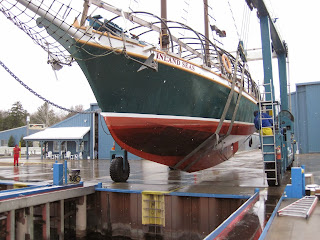
--Tom K.
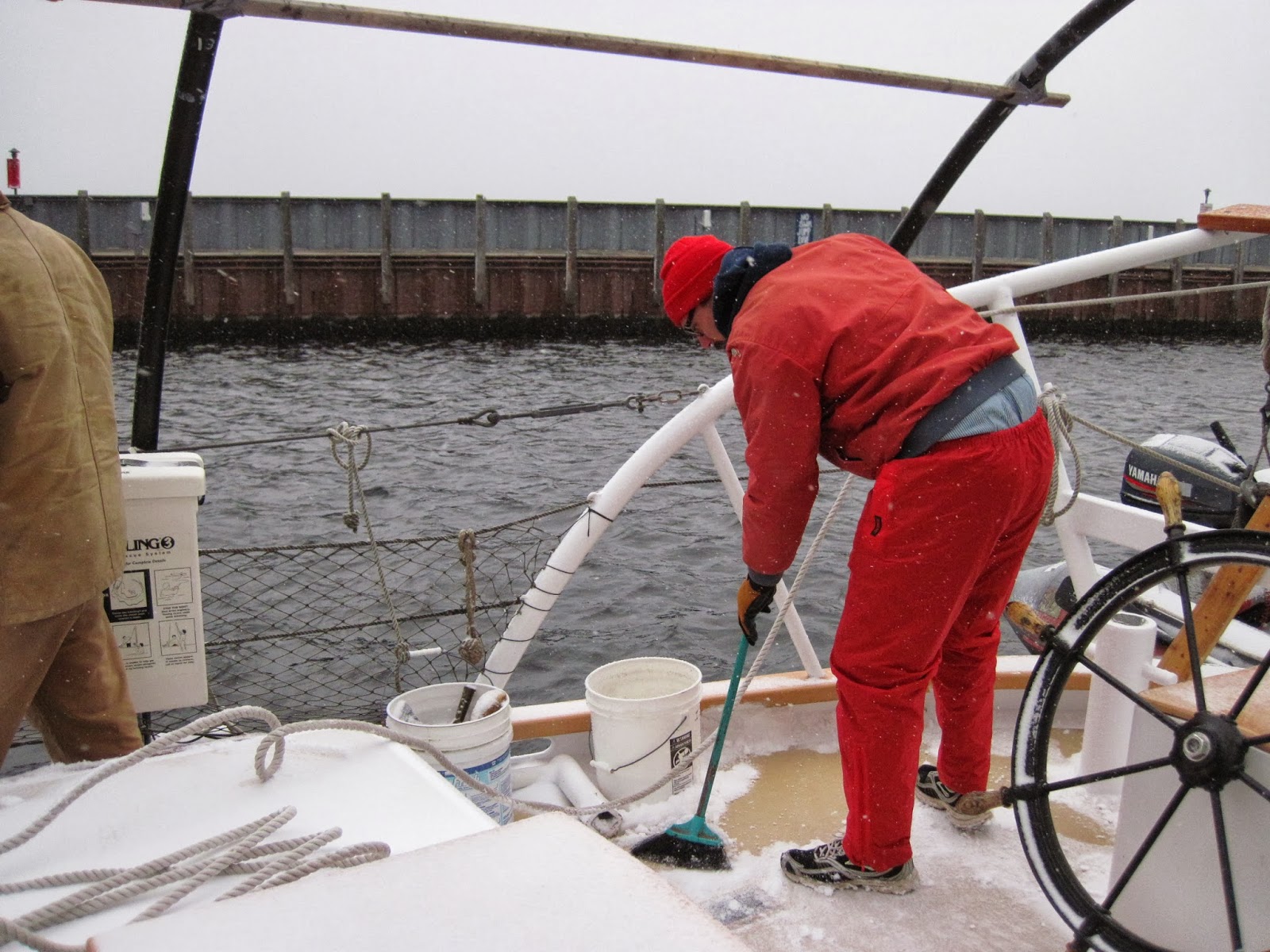 |
| Ben Clark sweeping off the snow prior to departure. |

 |
| Haul Out at NBBY in the snow |


--Tom K.
Thursday, October 31, 2013
ISEA Ship Lay-Up Report
All ISEA vessels are in lay-up mode. Inland Seas is at Northport Marina, ready for haul out next week at Northport Bay Boatyard. Our whaleboat Lake Sturgeon was hauled out Tuesday (thanks to Bob Joyce & his big truck). Our Boston Whaler is on its trailer in the parking lot. We still have lots to do before winter, but we are roughly on schedule (barring a sudden arrival of winter weather).
If you would like to help get the boats ready for winter, please call the ISEA office at 271-3077.
Thanks for visiting....Capt. Tom
If you would like to help get the boats ready for winter, please call the ISEA office at 271-3077.
 |
| ISEA's Boston Whaler workboat |
 |
| Motor whaleboat coming out for the winter at Suttons Bay
|
Wednesday, October 16, 2013
Whaleboat Color Tour is a Big Hit with Passengers
The whaleboat Lake Sturgeon was very busy this past weekend, with severn full trips on Friday afternoon and Saturday. The weather was near perfect, and everyone aboard had a great experience learning about the fall colors and the changing Great Lakes. Book your trip for this Saturday October 19 by calling the ISEA office at 231-271-3077.


Hope to see you again soon on the motor whaleboat Lake Sturgeon.
Capt. Tom Kelly
 |
| Leaving the dock |
 |
| Underway |


 |
| Suttons Bay from the water |

 |
| Mate Bob Hagerman |
 |
| Mate Allen Wolfe |

Hope to see you again soon on the motor whaleboat Lake Sturgeon.
Capt. Tom Kelly
Thursday, September 26, 2013
Young Men In Science Cruise
The Young Men In Science Cruise took place on September 21 & 22. After sampling in Suttons Bay and Omena Bay, Capt. Ben took the ship to Power Island. Mate Jan Hale went ashore and was replaced by Capt. Tom. We had smores on the Island that evening.
The next day we hoisted the anchor and sampled several sites in Grand Traverse Bay for zooplankton and benthos.
The student research groups made presentations of their results at the end of the program. Thanks to the students for a job well done.
-Capt. Tom
The next day we hoisted the anchor and sampled several sites in Grand Traverse Bay for zooplankton and benthos.
The student research groups made presentations of their results at the end of the program. Thanks to the students for a job well done.
-Capt. Tom
 |
| Power Island |
 |
| Windlass Work |
 |
| Abandon Ship Drill |
 |
| Alex, John & Skyler present their results |
 |
| Jesse and Kyle discuss plankton findings |
Tuesday, September 10, 2013
Evening Schoolship with NMC Watershed Class
 |
| Colleen and Capt. Ben |
.JPG) |
| Carol Inman at Weather Station |
 |
| John Casteel at Fish Station |
 |
| Sunset on Suttons Bay |
 |
| Virginia Tegel leading Stewardship Station
A fine evening on Suttons Bay, enjoyed by all. --Tom K.
|
Friday, September 6, 2013
Perfect Night for the Astronomy Cruise
Last evening we did our last Astronomy Under Sail Program for the 2013 season. We had 26 guests aboard and all had a great time listening to Dick Cookman and learning about the night sky.
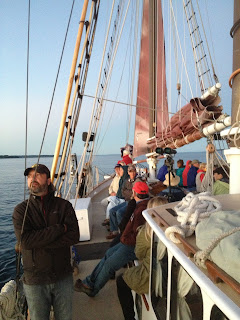
 I took these photos before it got really dark. The air temperature was 53 degrees when we got in.
--T. Kelly


--T. Kelly
Sunday, June 23, 2013
Manta Trawl Tested Aboard Inland Seas
During last week's Young Women in Science cruise, ISEA tested a Manta net, used to collect surface organisms and to look for micro-plastics (break-down products of plastic materials). The Manta net consists of an aluminum frame with welded aluminum "wings" on each side to keep the net on the surface, and a long net with 353 micron mesh size.
The net is pulled behind the schooner for 30 minutes at 2 knots. We did two trial runs, one in Suttons Bay and one in the West Arm of Grand Traverse Bay. The Suttons Bay sample consisted of a large amount of midge pupa cases, terrestrial insects, leaf matter and pollen. The West Arm sample had few terrestrial items, but did contain a lot of material that will need to be sifted through to see if there is any micro-plastic bits present. The samples were preserved in alcohol and will be given to Dr. Sherri Mason of the State University of New York - Fredonia for analysis.
We plan to take Manta net samples throughout June and July for Dr. Mason. This is part of a larger effort to describe the implications of micro-plastics on a world-wide basis.
Click here to see Dr. Mason's PowerPoint on plastic reduction ideas.
Click here to see the impact of plastic on Midway Island albatrosses.
Capt. T. Kelly
 |
| Manta Trawl being deployed from Inland Seas |
The net is pulled behind the schooner for 30 minutes at 2 knots. We did two trial runs, one in Suttons Bay and one in the West Arm of Grand Traverse Bay. The Suttons Bay sample consisted of a large amount of midge pupa cases, terrestrial insects, leaf matter and pollen. The West Arm sample had few terrestrial items, but did contain a lot of material that will need to be sifted through to see if there is any micro-plastic bits present. The samples were preserved in alcohol and will be given to Dr. Sherri Mason of the State University of New York - Fredonia for analysis.
 |
| Manta recovery after 30 minute tow. |
We plan to take Manta net samples throughout June and July for Dr. Mason. This is part of a larger effort to describe the implications of micro-plastics on a world-wide basis.
Click here to see Dr. Mason's PowerPoint on plastic reduction ideas.
Click here to see the impact of plastic on Midway Island albatrosses.
Capt. T. Kelly
Thursday, June 6, 2013
Re-Fit of ISEA's Motor Whaleboat Nearing Completion
Work continues on ISEA's ex-Navy motor whaleboat Lake Sturgeon. We are installing the new oak rub rails this week. The rails were built for us by George Powell and Bruce Lehmann at their shop in Suttons Bay. We still have a lot to do before our final US Coast Guard inspection, so if you would like to help contact Tom Kelly or Chuck Dickerson at 231-271-3077.
 |
| George, Bruce and Tony trial-fit the new rub rails |
 |
| Installation today. Ben Clark, new ISEA Intern, is assisting Bruce and Chuck Dickerson. |
 |
| Ben, Chuck and Jerry Battle. ------Tom K. |
Wednesday, May 29, 2013
Misty Morning Departure
Students from Tappen Middle School in Ann Arbor got a moist start to their Schoolship trip this morning. Later the fog lifted and the sky brightened.
 -T. K.

Tuesday, May 28, 2013
Gull Behavior Topic of Thursday's Great Lakes Seminar
On Thursday May 30th at 7pm, the Inland Seas Education Association will host a screening of the movie Signals for Survival, an in-depth study of behavior and communication of the lesser great blacked-backed and herring gulls. The viewing will be followed by a Q&A session with Dr. Bill Scharf, a local ornithologist. This seminar is FREE and OPEN TO THE PUBLIC.

Dr. Scharf has dedicated most of his career to the study of herring gulls. For over 30 years he has examined trends and noted abnormalities of gulls on Gull Island in Grand Traverse Bay. His research has helped the Leelanau Conservancy, who owns Gull Island, write a management plan that protects the island as it is home to thousands of herring gulls that nest there from April through June. Inland Seas will host a sail to Gull Island on Sunday, June 2nd, as part of the Leelanau Peninsula Bird Festival.
You can accompany Dr. Scharf and educators from the Leelanau Peninsula Bird Festival, Leelanau Conservancy and Inland Seas on a trip to Gull Island on Sunday, June 2nd. Click here for more infomation.
--Tom Kelly
Dr. Scharf has dedicated most of his career to the study of herring gulls. For over 30 years he has examined trends and noted abnormalities of gulls on Gull Island in Grand Traverse Bay. His research has helped the Leelanau Conservancy, who owns Gull Island, write a management plan that protects the island as it is home to thousands of herring gulls that nest there from April through June. Inland Seas will host a sail to Gull Island on Sunday, June 2nd, as part of the Leelanau Peninsula Bird Festival.
 |
| Dr. Bill Scharf aboard the Schoolship at Gull Island |
--Tom Kelly
Wednesday, May 1, 2013
25th Schoolship Season Begins
Today, May 1st, 2013, begins our 25th season providing ISEA's Schoolship Program to the students of Michigan. This spring we have 100 classes booked - a full schedule. Today we had Frankfort Elementary in the morning and Kennedy Elementary (Manistee) in the afternoon aboard Inland Seas and another Kennedy classroom aboard Manitou this afternoon. --Capt. Tom
 |
| Inland Seas departs this afternoon with Kennedy Elementary Students. Note the fine weather and clear water! |
Sunday, April 21, 2013
Great Lakes & Inland Lakes Cold Water Safety for Spring 2013
Great Lakes & Inland Lakes Cold Water Safety for Spring 2013
Coast Guard Recommendations for Keeping Safe on the Water in Spring, Especially for Canoeists, Kayakers & Boaters:
Coast Guard Cmdr. Buzzella reminds boaters that spring water temperatures are deadly cold, despite warming air temperatures and is working with local media to help Michigan learn how to enjoy the lakes safely in warm weather. During the week of April 15th, the USCG Air Station Traverse City is working with the media to demonstrate cold water recommendations, gear and safety procedures. Additionally, during spring local media will be reporting area water temperatures.
"Warm air inspires us all to get outside. When being outside means getting on the water, boaters put themselves in danger when they don't prepare for cold water," says Cmdr. Buzzella. "Even experienced boaters mistake a warm day for safe water temperatures and can fall prey to hypothermia if they end up in the water." Cold water carries heat away from the body 25 times faster than air of the same temperature and as a result, the body core immediately begins to lose heat. Strong currents, like rivers or waves can increase the speed of the heat loss.
The U. S. Coast Guard helped to produce this video on MyNorth.com and recommends the following advice for enjoying the Great Lakes and inland lakes this spring. http://www.mynorth.com/My-North/Video/Outdoors/?vid=5316
Know the Water Temperature
Weather reports on 9&10 News and 7&4 News will report spring water temperatures as part of their daily broadcast.
NOAA (National Oceanic & Atmospheric Administration) also provides daily reports at http://www.glerl.noaa.gov/res/glcfs/glcfs.php?lake=m&ext=swt&type=N&hr=03
Dress for the Water Weather
Wear a life jacket
Wear cold water clothing appropriate for the water temperature: wet suits, dry suits, etc.
Charles River Canoe & Kayak uses the following chart with the recommendation that some people need more protection from cold.
WATER TEMPERATURE: HYPOTHERMIA RISK APPROPRIATE CLOTHING
60°F and up low Clothing for the weather
55-59°F moderate Wetsuit or drysuit
45-54°F high Drysuit recommended
below 45°F extreme Drysuit
On average, water in Lake Michigan doesn't pass the 60 degree F mark until mid to late June. So paddlers should be looking at wetsuits or better all spring.
Source: http://coastwatch.glerl.noaa.gov/statistic/gif/avgtemps-m_1992-2012.gif
Two Boats Are Better
Many people don't put their boats in the water until June or July. In spring there are very few neighbors who are going to be able to use their boat to get to you, so it's better to have that second boat already with you. As fast as the Coast Guard is, it may take them 30 minutes to scramble a rescue team and get to you--if they know right where you are. And in cold water you might not have that much time.
In 2011 32 Great Lakes water fatalities were paddle craft fatalities. When paddling, in cold water, one boater can help the other out of the cold water and to shore where medical personnel can assist.
Take the Search Out of Search & Rescue--Use an EPIRB or PLB (personal locator beacon)
EPIRBs (emergency position-indicating radio beacons) and PLB's signal maritime distress. An activated EPIRB or PLB broadcasts a repeating SOS signal with integrated GPS location from virtually any point on earth. The signal is received by COSPAS/SARSAT satellites which identifies the beacon's position within a few hundred yards in mere minutes. Make sure your EPIRB/PLB has been registered with NOAA and that the information is up to date.
Flares, glow sticks, flashlights help rescue personal find your craft at night.
Protect your cell phone with a waterproof dry sack and attach that to your life vest.
Always file a float plan with a responsible person ashore. Tell them where your are going, what type of craft you are using, and when to expect you back. Call this person upon your return so they do not worry and call for a search.
Rachel North of Suttons Bay, lost her brother, an experienced sailor, kayaker and canoeist, David Dickerson, on April 21st last year to hypothermia. He went canoeing on Omena Bay on a bright spring day where the temperature topped 50 degrees and the wind was 5 mph. "He was always the capable guy, with the exact right gear and experience to handle any situation. One might see him practice emptying a waterlogged canoe in Omena Bay by pushing down the bow, lifting the stern up until the water emptied out and he would flip in," says North.
North explains, "Whatever turned him out of his canoe that day put him in 41 degree water wearing his life jacket, shorts and a fleece. The coroner's report indicated that he had about 6 minutes before hypothermia set in. And all the equipment he needed to survive that accident was in his closet. And even though I've boated on these lakes all my life, I wouldn't have stopped him and said, 'Hey, go get your wetsuit.' Well with the Coast Guard's help, we're changing that."
Rachel North hopes that by telling her brother's story and sharing all that she's learned, more people will own and use the proper clothing and equipment for spring and fall boating. And more people will pay attention to the water temperature when they go boating.
"Be safe, enjoy the Great Lakes in spring and take lots of pictures," says North.
For more information, visit http://www.mynorth.com/My-North/April-2013/Northern-Michigan-Outdoors-Cold-Water-Safety-with-the-US-Coast-Guard/.
Thanks to Rachel North for bringing this to the public's attention.
Coast Guard Recommendations for Keeping Safe on the Water in Spring, Especially for Canoeists, Kayakers & Boaters:
Coast Guard Cmdr. Buzzella reminds boaters that spring water temperatures are deadly cold, despite warming air temperatures and is working with local media to help Michigan learn how to enjoy the lakes safely in warm weather. During the week of April 15th, the USCG Air Station Traverse City is working with the media to demonstrate cold water recommendations, gear and safety procedures. Additionally, during spring local media will be reporting area water temperatures.
"Warm air inspires us all to get outside. When being outside means getting on the water, boaters put themselves in danger when they don't prepare for cold water," says Cmdr. Buzzella. "Even experienced boaters mistake a warm day for safe water temperatures and can fall prey to hypothermia if they end up in the water." Cold water carries heat away from the body 25 times faster than air of the same temperature and as a result, the body core immediately begins to lose heat. Strong currents, like rivers or waves can increase the speed of the heat loss.
The U. S. Coast Guard helped to produce this video on MyNorth.com and recommends the following advice for enjoying the Great Lakes and inland lakes this spring. http://www.mynorth.com/My-North/Video/Outdoors/?vid=5316
Know the Water Temperature
Weather reports on 9&10 News and 7&4 News will report spring water temperatures as part of their daily broadcast.
NOAA (National Oceanic & Atmospheric Administration) also provides daily reports at http://www.glerl.noaa.gov/res/glcfs/glcfs.php?lake=m&ext=swt&type=N&hr=03
Dress for the Water Weather
Wear a life jacket
Wear cold water clothing appropriate for the water temperature: wet suits, dry suits, etc.
Charles River Canoe & Kayak uses the following chart with the recommendation that some people need more protection from cold.
WATER TEMPERATURE: HYPOTHERMIA RISK APPROPRIATE CLOTHING
60°F and up low Clothing for the weather
55-59°F moderate Wetsuit or drysuit
45-54°F high Drysuit recommended
below 45°F extreme Drysuit
On average, water in Lake Michigan doesn't pass the 60 degree F mark until mid to late June. So paddlers should be looking at wetsuits or better all spring.
Source: http://coastwatch.glerl.noaa.gov/statistic/gif/avgtemps-m_1992-2012.gif
 |
| The well dressed cold water paddler. kayakquixotica.com |
Two Boats Are Better
Many people don't put their boats in the water until June or July. In spring there are very few neighbors who are going to be able to use their boat to get to you, so it's better to have that second boat already with you. As fast as the Coast Guard is, it may take them 30 minutes to scramble a rescue team and get to you--if they know right where you are. And in cold water you might not have that much time.
In 2011 32 Great Lakes water fatalities were paddle craft fatalities. When paddling, in cold water, one boater can help the other out of the cold water and to shore where medical personnel can assist.
Take the Search Out of Search & Rescue--Use an EPIRB or PLB (personal locator beacon)
EPIRBs (emergency position-indicating radio beacons) and PLB's signal maritime distress. An activated EPIRB or PLB broadcasts a repeating SOS signal with integrated GPS location from virtually any point on earth. The signal is received by COSPAS/SARSAT satellites which identifies the beacon's position within a few hundred yards in mere minutes. Make sure your EPIRB/PLB has been registered with NOAA and that the information is up to date.
Flares, glow sticks, flashlights help rescue personal find your craft at night.
Protect your cell phone with a waterproof dry sack and attach that to your life vest.
Always file a float plan with a responsible person ashore. Tell them where your are going, what type of craft you are using, and when to expect you back. Call this person upon your return so they do not worry and call for a search.
Rachel North of Suttons Bay, lost her brother, an experienced sailor, kayaker and canoeist, David Dickerson, on April 21st last year to hypothermia. He went canoeing on Omena Bay on a bright spring day where the temperature topped 50 degrees and the wind was 5 mph. "He was always the capable guy, with the exact right gear and experience to handle any situation. One might see him practice emptying a waterlogged canoe in Omena Bay by pushing down the bow, lifting the stern up until the water emptied out and he would flip in," says North.
North explains, "Whatever turned him out of his canoe that day put him in 41 degree water wearing his life jacket, shorts and a fleece. The coroner's report indicated that he had about 6 minutes before hypothermia set in. And all the equipment he needed to survive that accident was in his closet. And even though I've boated on these lakes all my life, I wouldn't have stopped him and said, 'Hey, go get your wetsuit.' Well with the Coast Guard's help, we're changing that."
Rachel North hopes that by telling her brother's story and sharing all that she's learned, more people will own and use the proper clothing and equipment for spring and fall boating. And more people will pay attention to the water temperature when they go boating.
"Be safe, enjoy the Great Lakes in spring and take lots of pictures," says North.
For more information, visit http://www.mynorth.com/My-North/April-2013/Northern-Michigan-Outdoors-Cold-Water-Safety-with-the-US-Coast-Guard/.
Thanks to Rachel North for bringing this to the public's attention.
Subscribe to:
Posts (Atom)


