Showing posts with label ecology of Grand Traverse Bay. Show all posts

Saturday, April 6, 2013

First Bloody Red Shrimp Record for Suttons Bay

The first sighting of a bloody red shrimp, Hemimysis anomala, was made today in a sample from an experimental plankton pump, set up to run overnight at the ISEA Schooner Dock in Suttons Bay.  This animal is an invasive species from the Black - Azov - Caspian Sea area of Eurasia.  It likely got to the Great Lakes in the ballast water of ships.  For more on Hemimysis ecology, look at the USGS Nonindigenous Aquatic Species web site.

The plankton pump was in its first overnight test, starting on Friday afternoon, April 5, 2013.  The pump was at 0.84 meters depth on a rocky substrate. Unfortunately the battery did not have enough capacity to run the pump for 24 hours, so the next test will incorporate an inverter or battery charger to keep the battery voltage the same throughout the pumping period.  Despite the failure of this first test to give a quantitative result, we did find what we were looking for, the bloody red shrimp.  This zooplankton has been previously found in Muskegon Lake and Elk Rapids. 

After the plankton pump sampler is perfected we intend to sample a number of harbors in NW Michigan, and we will add this to the sampling gear of the Schoolship Inland Seas to sample ports visited this summer.

Hemimysis collected from Suttons Bay, April 5 - 6, 2013

Hemimysis tail section showing telson

Hemimysis showing characteristic twin spikes on the squared-off telson
More results will be posted on this blog as they become available.

-Thomas M. Kelly - ISEA Executive Director
-Graham P. Kelly - ISEA Student Intern

Friday, April 5, 2013

SB Student Intern Graham Kelly Launches Zooplankton Pump Sampler

ISEA's high school intern Graham Kelly initiated the first test of his zooplankton pump sampler at the ISEA schooner dock today.  The sampler consists of a submersible Rule bilge pump, hose, 153 micron plankton net, and car battery.  This first test will run overnight to determine the effectiveness of this method on night-active zooplankton (knowing that the numbers and species diversity is limited at this time of year).   Graham and his dad will return to the dock tomorrow to collect the sample. 

An earlier test showed that copepods can pass through the device intact. 
Graham with zooplankton pump sampler

Checking flow into net

Car battery, graduated cylinder (used to measure flow rate), volt meter

Pump, hose and net.  Battery is now covered by plastic box. 

We'll publish results as available. 

--Co-Investigator & Dad,   Tom K. 

Monday, February 25, 2013

Inland Seas Featured in Crusing Grand Traverse Bay Interview

ISEA is featured in a video interview about protecting water quality in Grand Traverse Bay.  Steve Morse, a long-time friend of ISEA, developed this program to inform boaters about the need to protect Grand Traverse Bay's water quality, and the work of two organizations involved with this work, ISEA and the Watershed Center.  Click here to see the video.  You can see Steve's entire program about Grand Traverse Bay from a boater's prospective by clicking here.


Inland Seas at her dock in Suttons Bay  - ISEA Photo
--Capt. Tom

Tuesday, December 11, 2012

Schoolship Year in Review This Wednesday

The Inland Seas Education Association (ISEA) will present a seminar that focuses on the work of the Schoolship Inland Seas and the current ecological status of Grand Traverse Bay at 7:00 pm on Wednesday, December 12th, at the Inland Seas Education Center in Suttons Bay. The program will be presented by Tom Kelly, Executive Director of ISEA. This seminar is free and open to the public.

Advanced Invasive Spieces Field Course Students (teachers) in the Straits of Mackinac
During the 2012 navigation season, ISEA’s 77 foot schooner Inland Seas sailed the waters of Grand Traverse Bay and northern Lake Michigan, visiting 13 ports with students from all across the state of Michigan. Together with the schooner Manitou, ISEA provided shipboard science programs for 4,175 students in 2012. Since its founding in 1989, ISEA has sailed with 94,609 students and teachers.

The major findings this year relate mainly to the continued impact of invasive species on the lower food web in Grand Traverse Bay and Lake Michigan. The round goby, an invasive fish, dominated the forage fish community in the near shore waters. Water clarity continued to increase, largely due to particle filtering by quagga mussels, which have largely replaced zebra mussels in Lake Michigan. Kelly will also discuss the recent lowering of lake levels and the prognosis for 2013.

Hope to see you there!


Monday, March 12, 2012

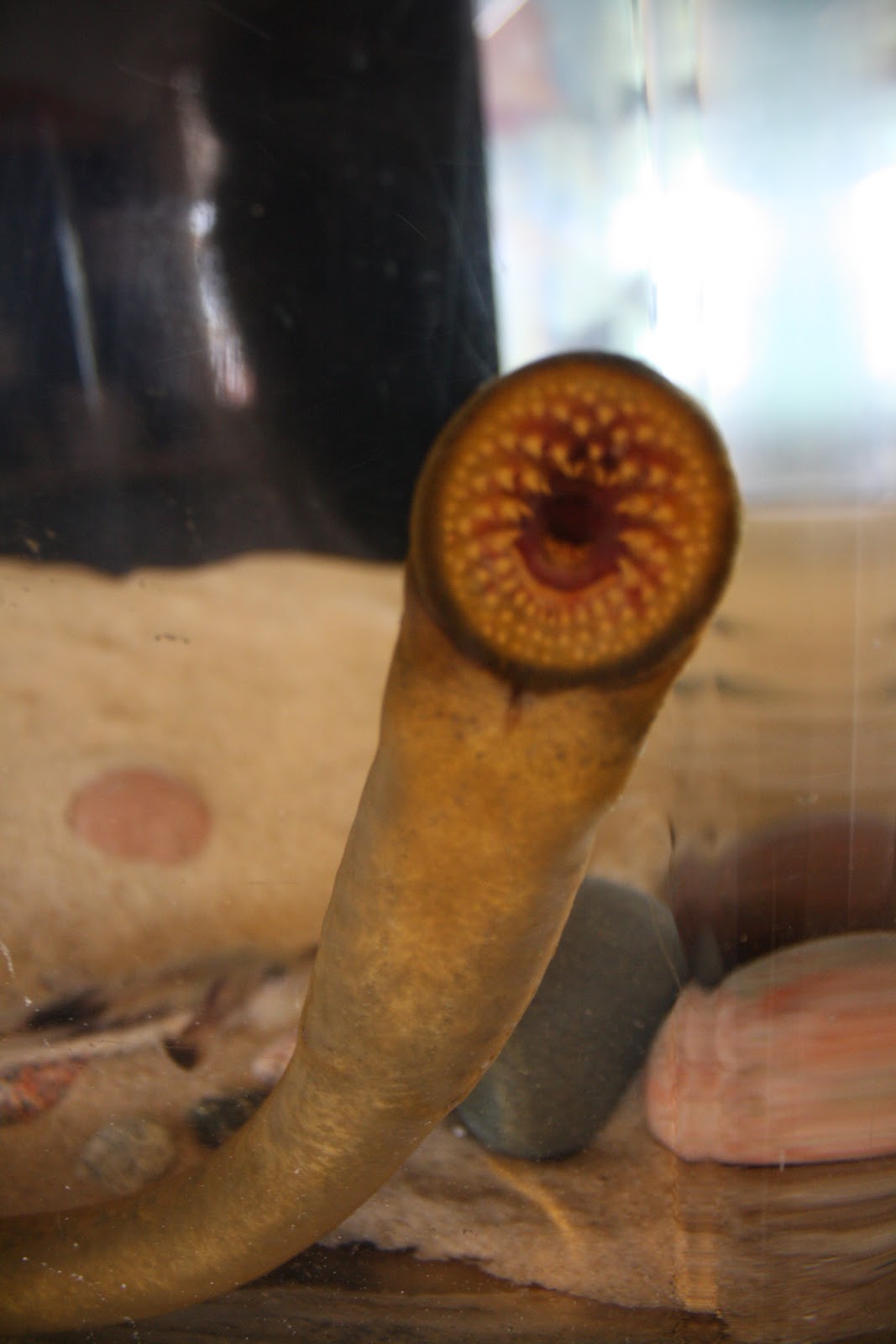
The Sea Lampreys are Coming!

Great Lakes Seminar at Inland Seas on Tuesday, March 13, 7:00 pm. 
Business end of a Sea Lamprey.  In ISEA's tank last June.
Please join us at the ISEC for a presentation by Michael Wagner, Assistant Professor and PERM Scientist at MSU, about new sea lamprey barrier methods. Check out the link below to see what Michael has been working on.
http://www.youtube.com/watch?v=BxvorkIBbOo

You can visit Dr. Wagner's web site at http://www.fw.msu.edu/~mwagner/

Saturday, January 14, 2012

Sturgeon Feeding Frenzy


Here are ISEA's five little lake sturgeon feeding on bloodworms and mysis shrimps. 

Learn more about efforts to rehabilitate Lake Michigan's lake sturgeon populations on February 14 when Marty Holtgren of the Little River Band of Ottawa Indians presents "Sturgeon Research in the Great Lakes and Planning for their Future" at the next ISEA Great Lakes Seminar.
Tuesday February 14
7pm
Inland Seas Education Center, Suttons Bay
Free and Open to the Public

Friday, November 25, 2011

Round Goby Invades Streams

See the video of round goby invasion of streams in Wisconsin.  Click here!  --Capt. Tom
Round Goby.  Photo by Chris Doyle.

Historic Changes to the Lower Food Web of Lake Michigan

If you missed Gary Fahnenstiel's presentation at the Freshwater Summit in October here is the video produced by Bob Russell:  Click Here  This is required viewing for anyone trying to understand what's happening in Lake Michigan.  Gary Fahnenstiel works for the NOAA Great Lakes Environmental Laboratory in Muskegon.  --Capt. Tom
Quagga Mussel

Friday, November 11, 2011

Climate Change and the Great Lakes

Get the climate change facts from Don Scavia at University of Michigan.  Don Scavia is Graham Family Professor and Director, Graham Sustainability Institute; Special Counsel to the U-M President on Sustainability; Professor, School of Natural Resources & Environment; and Professor, Civil and Environmental Engineering. 

Prof. Don Scavia
This is a 33 minute video, so find some quality time for yourself, and you will be well rewarded for your interest.

Click here to begin the video Climate Change in the Great Lakes Region.

--Tom Kelly

Tuesday, November 8, 2011

Free Seminar Tonight on Stormwater Treatment Techniques

Suttons Bay, MI – The Inland Seas Education Association will present a seminar focusing on stormwater treatment within the Great Lakes watershed at 7:00pm on Tuesday, November 8th, at the Inland Seas Education Center in Suttons Bay. The program will be presented by Sarah U’Ren, Program Director at the Watershed Center Grand Traverse Bay. This seminar is FREE and OPEN TO THE PUBLIC.

Outfall of Broadway Street Drain in Suttons Bay

Plume of contaminated water in Suttons Bay from Broadway Drain after rain event.
The Watershed Center is a non-profit organization located in Traverse City, dedicated to the protection of our water resources in Grand Traverse Bay. They work within the entire 1,000 square mile watershed to advocate for clean water through public education and on-the-ground projects. One such project currently underway is working towards improved runoff filtration systems in Suttons Bay and Traverse City. Land use management within the watershed is an important aspect of maintaining water quality, as poor land use practices can lead to public health concerns and degraded ecosystem health. “By managing runoff from the three largest storm drains in Suttons Bay, we hope to drastically decrease public health risks at local beaches associated with runoff,” says U’Ren.

Tuesday, August 9, 2011

News of Sea Lamprey Repellant

Research at MSU has come up with a potential sea lamprey repellant.  Learn more by clicking here.

Sea Lamprey caught in the Boardman River on display at the Inland Seas Education Center
Donated by the Grand Traverse Band of Ottawa & Chippewa Indians who operate the lamprey trap on the Boardman River.

Friday, August 5, 2011

More Photos of the LSSU Oceanography Trip

Prof. Derek approaching the Bridge

Tyler

Tom Kastle under the the "Big Mac"

Good Sailing! (Kathy K. in her new Beaver Island hat)

Capt. Tom with the ill-fated core sampler - we never did get it to work.

Monday, April 18, 2011

Hit the Beaches for the 2011 ISEA Beach Clean-Up

ISEA Spring Beach Clean-Up, May 23 - May 10, 2011
Beginning this weekend, April 23rd, and until May 10th, you can help clean up the beaches of the Grand Traverse Bay region (river and stream banks are included).  Just go to the ISEA web site schoolship.org and download a Beach Clean-Up data sheet. Then gather some friends and pick up and record what you find. Please recycle everything possible.  We would also like to get photos of your group.  Send photos to tkelly@schoolship.org.  For more information on the Beach Clean-Up, call Sally Somsel at 231-946-8090.

Friday, November 12, 2010

"An Ecological History of Grand Traverse Bay" to be Presented in Elk Rapids

The Elk Rapids Area Historical Society’s final program for 2010 is, “An Ecological History of Grand Traverse Bay.” It will be presented by Tom Kelly on Wednesday November 17th, 7:00 p.m. at the Historic Elk Rapids Township Hall, 401 River Street (across from the tennis courts). Note: this is the only Wednesday night program this season.
Zebra Mussels in Grand Traverse Bay.  Chris Doyle Photo

An Ecological History of Grand Traverse Bay is a program that tells the story of the changing environment of the Grand Traverse Bay region, from the glaciers to the present day.

There are many stories to be told, from the immense continental glaciers of the late Pleistocene to the tiny zebra mussels and other invader species that have transformed the Bay in the last few decades.

The effects of lumbering, fishing, damming, farming and urbanization are included, as is a peak through the curtain into the future ecology of the Bay.

Tom Kelly is the Executive Director of the Inland Seas Education Association (ISEA). He has worked for the University of Michigan as a limnologist on the Great Lakes and inland lakes, and as a Sea Grant Marine Field Agent in Traverse City, MI. Beginning in 1978, he did consulting work in fisheries and water quality. In November 1986 Tom sailed aboard the sloop Clearwater doing environmental education programs for students in the Hudson River Valley. This experience led to the formation, in 1989, of the Inland Seas Education Association. Tom is currently the Captain of ISEA’s flagship, the 77’ schooner Inland Seas.

Tom’s greatest joy comes from bringing the wonders of the Great Lakes to those who have not experienced them before. During the 2010 ISEA Schoolship season, 3,284 students sailed on the schooner Inland Seas (86,393 since Inland Seas Education Association was founded in 1989).

ISEA conducted dockside programs for 4,263 people at the Escanaba City Marina, Fayette State Park, Traverse City Film Festival, Tall Ships Chicago, and the Michigan Schooner Festival. Additionally, ISEA’s Summer Music Festival attracted 1,300 people.

Admission Fee: $5.00 suggested donation for adults and $2.00 donation for students (under age 18) is requested at the door for these programs. Any free-will donation will be graciously accepted! All proceeds benefit the Elk Rapids Area Historical Society.

For more information contact Dan LeBlond, President, Elk Rapids Area Historical Society;

Tel. 231-264-8984 or send e-mail to: president@elkrapidshistory.org. Visit our website at: http://www.elkrapidshistory.org/calendar.htmto view a listing of 2011 programs and special events.